
Control-IQ+ Technology: How Does It Advance Automated Insulin Delivery for Type 2 Diabetes?

This educational article was made possible with materials and support from Tandem Diabetes Care.
Automated insulin delivery (AID) systems have been traditionally used by people with type 1 diabetes but are now more widely available for those with type 2 diabetes after the approval of several major systems in 2025, including the Tandem Diabetes Care t:slim X2 insulin pump and Tandem Mobi system with Control-IQ+ technology, the predictive algorithm with research-proven results.
Historically, people with type 2 diabetes who require insulin have been limited to multiple daily injections (MDI). Research has found that AID systems offer many of the same benefits for people with type 2 diabetes as they do for type 1, including lower A1C, improved time in range, and reduced hypoglycemia.
AID systems have been traditionally used by people with type 1 diabetes, but are now getting traction for people living with insulin-dependent type 2 diabetes as companies like Tandem Diabetes Care work to expand global access to systems like the t:slim X2 insulin pump and Tandem Mobi system with Control-IQ+ technology.
A strong recommendation for AID use in type 2 diabetes was recently released in the American Diabetes Association’s 2026 Standards of Care in Diabetes, citing AID as the preferred insulin delivery system for people with type 2 diabetes who require insulin. The recommendation is based on March 2025 study showing that participants using Control-IQ+ saw a greater reduction in A1C compared to those who were not using an AID system.
Christopher Layson, 61, who was diagnosed with type 2 diabetes in 2012, said for years that his blood sugar was difficult to manage, with blood sugar readings routinely over 500 mg/dL, despite taking multiple medications.
Medication and lifestyle changes can be very effective for many people with type 2 diabetes, but for some – like Layson – medications simply don’t work as well, and insulin may become necessary.
“My A1C was always around 13%, with the lowest reading at 11.2% as far back as I can remember,” he said.
In 2024, he was referred to a new care team in Florence, Alabama, which prescribed him a blood glucose monitor and a Tandem insulin pump, which he said drastically improved his ability to manage his glucose.
“These tools have literally saved my life,” Layson said. “I am now able to have my numbers monitored and displayed on a pump that is easy to attach and detach, and it automatically makes adjustments to lower my blood sugar and helps prevent lows.”
What is Control-IQ+?
Control-IQ+ (new March 2025, former version was Control-IQ technology) is the advanced algorithm used in Tandem AID systems, the Tandem Mobi and t:slim X2 pump. It helps simplify diabetes management by automatically adjusting continuous (basal) insulin delivery every five minutes and delivering automatic correction doses if blood sugar is anticipated to rise above 180 mg/dL.
Based on continuous glucose monitoring (CGM) data, the system will automatically decrease or stop basal insulin if blood sugar is predicted to be low and will increase if predicted to be high, taking much of the guesswork out of when and how much to bolus.
Control-IQ+ can also be used to address short-term blood sugar needs, for example, during exercise and sleep, when a person might want to change glucose treatment ranges to prevent hypoglycemia and hyperglycemia. It also has a unique AutoBolus feature, which can help with missed meal boluses and deliver corrections to help prevent high blood sugar.
In the 2025 study, people with type 2 diabetes using Control-IQ+ saw their A1C levels drop by 0.9% and their time in range (70-180 mg/dL) increase by 16% over 13 weeks.
Tandem AID system is approved for people ages 2 and older with type 1 diabetes, and as of February 2025, for adults 18 and older with type 2 diabetes. The t:slim X2 pump with Control-IQ+ was the first pump in the US to integrate with Abbott’s FreeStyle Libre 3 Plus , and is also compatible with Dexcom G6 and G7. The Tandem Mobi system is compatible with Dexcom G7 sensors.
Tandem Mobi and t:slim X2 pumps both disconnect at the infusion site, which many users find helpful for swimming, running, and other aerobic activities that may lower blood glucose, or during high-contact sports when an attached pump is inconvenient.
Beyond adjusting insulin every five minutes based on CGM values, some of the enhancements with Control-IQ+ include:
- User weight 20-440 pounds (previously 55-308 pounds)
- User total daily insulin (TDI) 5-200 units (previously 10-100 units)
- Temp Rate, also known as “temporary basal rate,” allows users to temporarily increase or decrease their programmed basal insulin delivery for a set period of time, when Control-IQ+ technology is turned on or off. This feature can be beneficial to manage blood sugar levels during situations when more or less insulin might be needed like illness, stress, fasting, etc.
- Extended Bolus for up to eight hours when Control-IQ+ is turned on. An Extended Bolus allows the user to deliver a portion of the bolus immediately and the rest gradually over a set period of time, up to eight hours. This feature can be beneficial for managing blood glucose spikes after meals, for example, with meals that are high in fat or protein that take longer to digest or with conditions like gastroparesis.
How to start Control-IQ+ and optimize settings for type 2 diabetes
For people with type 2 diabetes who are transitioning from MDI and just getting started with Control-IQ+, there are initial recommended steps. Of course, when first starting out on an AID system, it’s important that people with type 2 diabetes work with a healthcare provider or diabetes education specialist on optimizing pump settings.
Using the Tandem Source platform, users can share diabetes data with a healthcare provider for reviewing glucose trends and dashboards, which can be especially helpful at the start.
- Calculate user-adjusted settings using AACE guidelines:
- Set basal rate: The AACE recommendation is the TDI x 0.5/24 hours. For example, if someone is using 100 units of insulin per day while on injections, the suggestion is to start their basal rate at 100 x 0.5/24 hours. Additionally, for those transitioning from MDI, the AACE guidelines recommend reducing the patients TDI by 25% first and then calculating their settings for basal, carb ratio, and correction factor. That works out to: 100 x .75 = 75 Units and 75 Units x.5/24 = 1.56 U/hr.
- Setting carb ratio: To calculate carb ratio take 450 and divide by TDI (at 25% reduction for someone coming from MDI). Using the above example, 450/75=6.
- Setting correction factor: This is the amount of insulin it takes to bring glucose levels down to target. The formula is 1700/TDI, so in this case, 1700/75 = 23. That means one unit of insulin would bring glucose levels down by 23.
- Turn on Control-IQ+: Once it’s turned on, the device prompts the user to input their weight and TDI.
- See immediate improvements: Control-IQ+ has no learning time. Improvements were seen in the first 24 hours. Link: [https://journals.sagepub.com/doi/10.1089/dia.2022.0558?cf-mal-redirected=true&]
Solving for real life
Once the user is accustomed to understanding and reviewing their glucose patterns, they will become more comfortable with how to personalize the initial settings. Of course, users should always consult a healthcare provider or diabetes education specialist before adjusting settings.
Morning hyperglycemia: If the user's blood glucose is trending high when they wake up, adjusting the basal rate to be higher in the middle of the night or using a stronger correction factor (meaning the impact of a unit of insulin would be lower during that time window) are options.
Post-meal hyperglycemia: If the user notices blood glucose trends high after meals, making the insulin-to-carbohydrate ratio stronger means the pump will deliver more insulin per gram of carbohydrate entered the insulin pump's display.
Although the Tandem Mobi and t:slim X2 pumps calculate needed insulin based on carbohydrate counting, there are other ways to use them that also have been shown to reduce blood glucose levels and increase time in range. One such method was highlighted in the type 2 study where participants used three different standard bolus amounts for meals with small, medium, or large portions of carbohydrates. For one of the study participants, this method showed a reduction in A1C from 12% to 7.9% after 13 weeks, and an increase in the amount of time in range from 12% to 66%.
Here’s a sample scenario below.
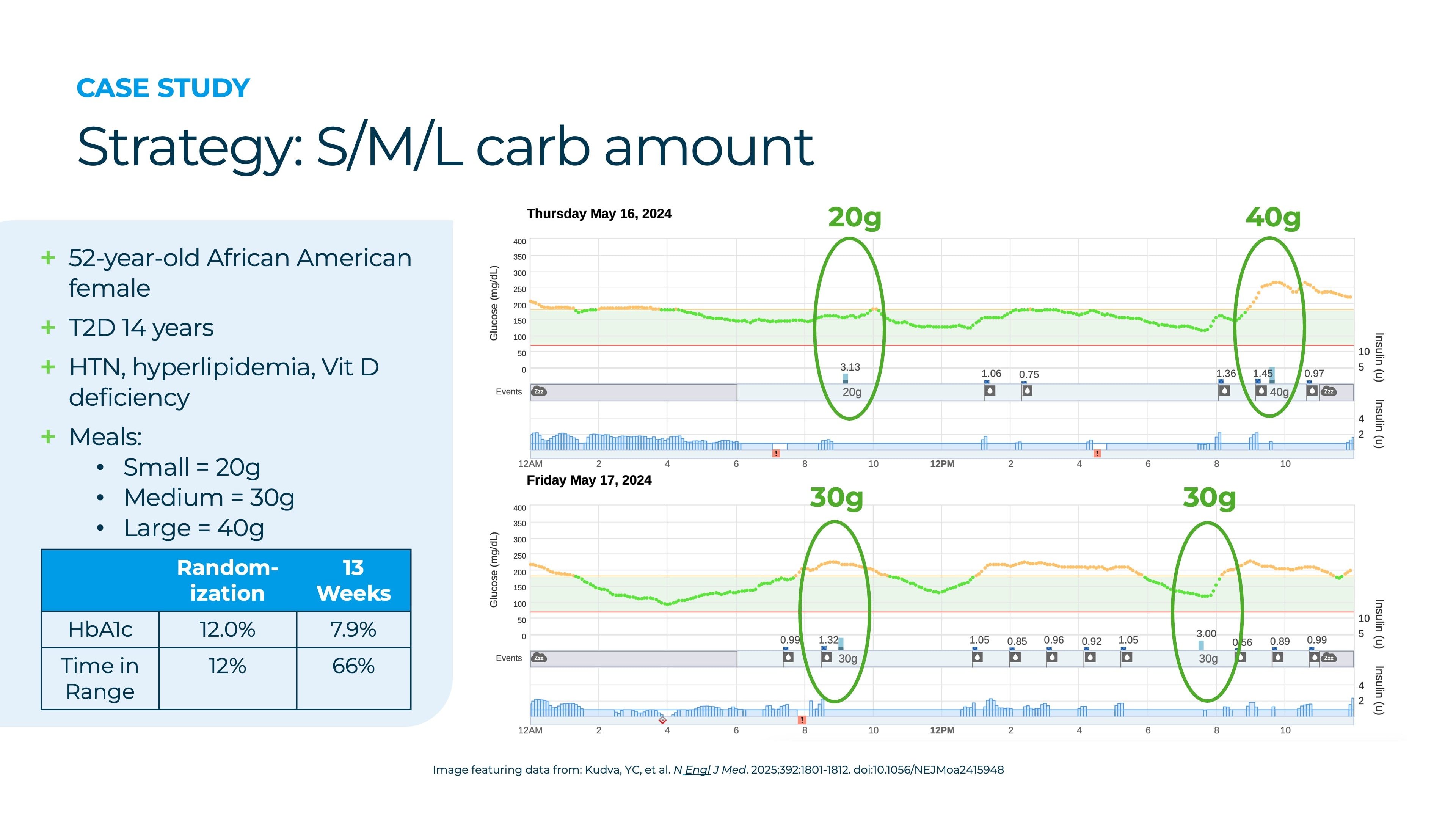
Another example showed a participant who chose the same bolus amount for each meal. This method showed a reduction in A1C from 7.4% to 6.3% after 13 weeks, and an increase in the amount of time in range from 52% to 84%.
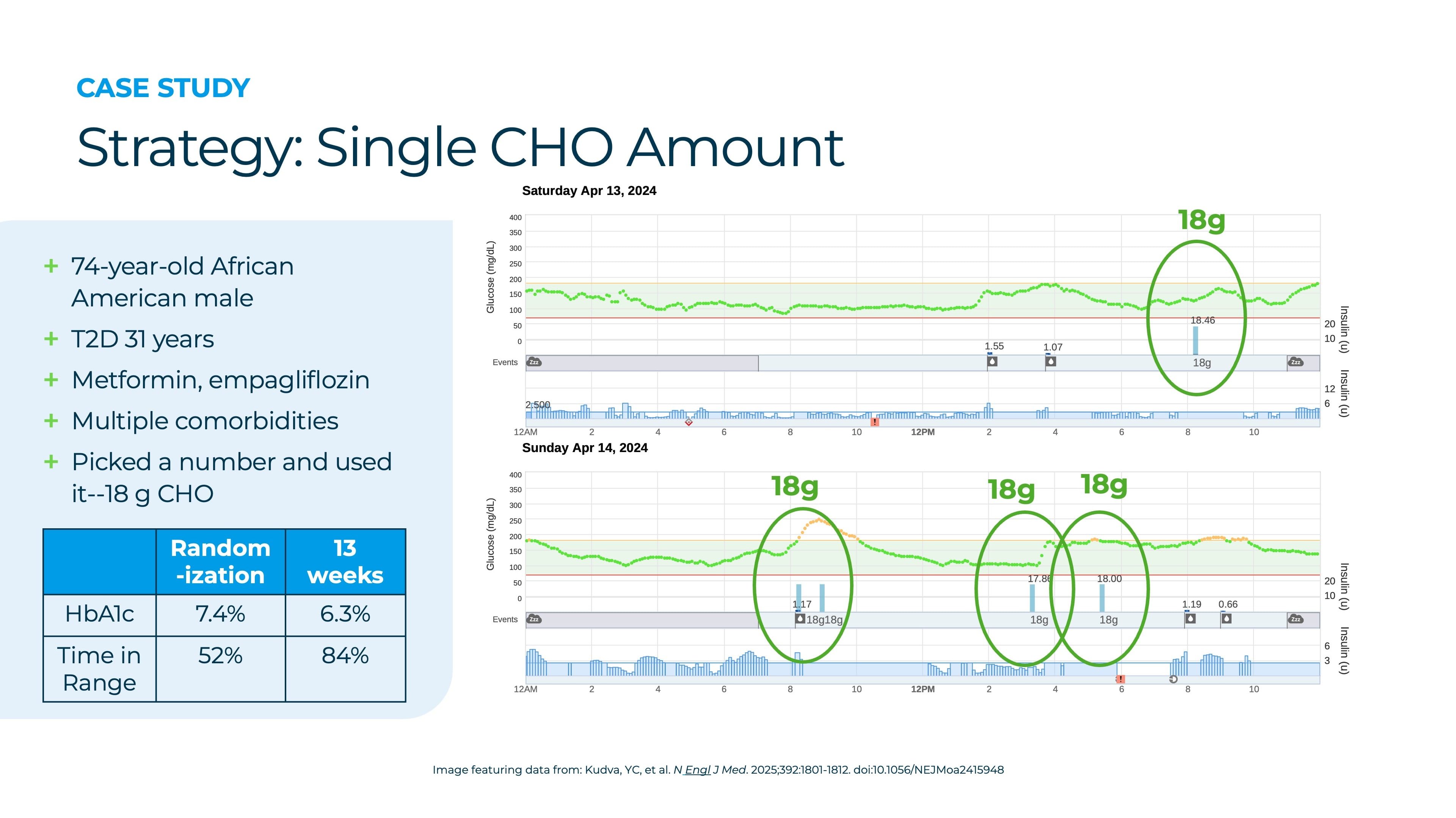
Images courtesy of Tandem Diabetes Care.
Does medical insurance cover Control-IQ+?
Many commercial insurance plans cover AID systems. Tandem pumps and supplies are available through the pharmacy channel as of March 3, 2026, which can result in a $0 copay with Tandem’s copay card through the newly launched Tandem Pump Rx hub. The $0 out-of-pocket claim is based on initial evaluation of coverage for Tandem customers with pharmacy benefits. Interested customers should contact Tandem for a free benefits check to determine actual cost for their situation.
Medicare may require documentation, such as a C-peptide test, which measures a person’s rate of insulin production. The challenge here is that many people with type 2 can still benefit from AID technology, regardless of their C-peptide levels. Layson, who is a Medicare beneficiary, said he was recently denied coverage of the gear needed to use his insulin pump based on his C-peptide results.
“I am insulin dependent, regardless of what my test results are,” he said. “Losing coverage to my pump and supporting equipment puts my health at serious risk. Within two weeks of losing access to my pump supplies, I was hospitalized for 10 days with diabetic ketoacidosis.”
The tide may be changing for C-peptide, though, with the recently released ADA 2026 Standards of Care in Diabetes stating that there should be no C-peptide requirement for insulin therapy, including AID systems.
Right now, the Centers for Medicare and Medicaid Services (CMS) is reviewing the language around this issue. If you live with or support someone with diabetes, contact your state representative to help make a change.
Looking ahead
Following the FDA clearance of Control-IQ+ for use by people living with diabetes in 2025, access to AID technology is rapidly expanding for people with type 2 diabetes who require insulin.
Numerous studies have shown the benefits of AID—and, specifically, Control-IQ+ —for improving A1C and time in range, while minimizing the risk of severe hypoglycemia. Moving from MDI to automated insulin can greatly simplify type 2 diabetes management.
Now, the focus needs to be on educating people with diabetes and their healthcare teams to feel confident in starting, using, and personalizing an AID system to their unique needs.
Learn more about Control-IQ+ and AID systems on DiaTribe here:
- Top Tips for Controlling Control-IQ+
- All About the Tandem Mobi
- Decoding Diabetes: Automated Insulin Delivery
Important Safety Information: RX ONLY. Indicated for patients with type 1 diabetes, 2 years and older and for patients with type 2 diabetes, 18 years and older. BOXED WARNING: Control-IQ+ technology should not be used in anyone under the age of 2 years old with type 1 diabetes or under the age of 18 years old with type 2 diabetes. It should also not be used in patients who require less than a total daily insulin dose of 5 units of insulin per day or who weigh less than 20 pounds, as those are the required minimum values needed for Control-IQ+ to operate safely. Safety info: tandemdiabetes.com/safetyinfo.