
5 Minutes With T1D Scout Founder Yuta Matsuda

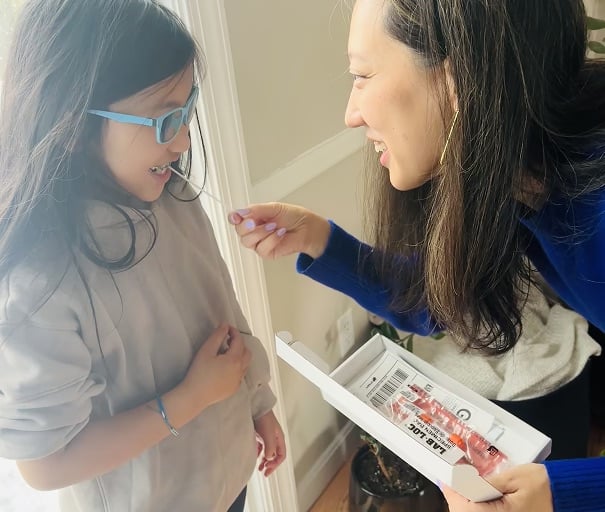
T1D Scout sends a kit containing a saliva-based DNA test, which can help establish risk of developing type 1 diabetes. Results are returned to a user's private online account in about three weeks.
T1D Scout founder Yuta Matsuda explains how the swab-based, at-home genetic testing he developed works – and how it can help more families access type 1 diabetes screening.
Type 1 diabetes screening typically requires a blood test. Yuta Matsuda, a geneticist based in Japan, developed an at-home genetic test that starts with a saliva swab instead. If the test shows higher genetic risk, families can follow up with at-home antibody testing.
Matsuda said the goal is to make screening easier to access and more likely to be completed – especially for families who may have trouble getting to a research site or completing a blood test with a young child.
He spoke about how genetic testing can help identify who may need closer monitoring with antibody testing, and how wider screening could help more people spot type 1 diabetes risk before serious complications like diabetic ketoacidosis (DKA) occur at diagnosis.

What led you to start T1D Scout?
I’ve worked in genetic research and the genetic testing industry for more than 15 years. For the past three years, I’ve been focusing on type 1 diabetes and genetics.
I also have a personal connection to type 1 diabetes. My mother was an endocrinologist in Japan, so I was familiar with diabetes from childhood. She retired this year, so I’m kind of carrying on her mission of helping people living with type 1 diabetes, using my professional background.
What problem does this form of type 1 testing try to solve?
Early detection of type 1 diabetes is very important because it can reduce the risk of DKA. It is also becoming more important with the approval of the first drug (Tzield) that can delay the onset of type 1 diabetes.
Current programs often require blood testing and may involve travel to a research site. That creates limited geographic access. Blood testing can also be a barrier, especially for small children. Cost is another issue, as screening everyone every year with antibody testing is not cost-efficient. As a result, only a small share of families affected by type 1 diabetes have been screened.
How does T1D Scout work?
The program is fully online. Families can register and enroll online, create an account, enter family information, receive an at-home genetic testing kit, collect a sample with a swab, and return it.
We provide the test result. We also provide at-home antibody testing for people who are at higher risk. That testing can occur every year to monitor the progression of type 1 diabetes.
How is genetic testing different from antibody testing?
Antibody testing is the gold standard for identifying where someone is in the type 1 diabetes process. Genetic testing identifies who is at risk – the future risk of developing type 1 diabetes. The two tests are complementary. By using genetic testing for initial screening, we can identify who should be monitored with antibody testing.
What does the swab test identify?
The genetic test looks at about 50 genetic markers related to type 1 diabetes. There are known genetic markers that are strongly correlated with type 1 diabetes risk. We take those markers, create a formula, and calculate a score. A higher score means a higher risk of developing type 1.
Some of those markers are in the HLA region, which is related to human autoimmunity. Others are related to insulin production. Some markers are statistically associated with type 1 diabetes risk, even though we do not yet know how they work biologically. We combine the known and unknown genetic markers to calculate the risk score.
What have you seen so far?
Within the first two weeks, about 3,000 families registered. Many had never been screened for type 1 diabetes before. In the higher-risk group, about 10% tested positive for autoantibodies, compared with about 1% in the lower-risk group.
What happens if someone is found to be at higher risk or tests positive for autoantibodies?
 Our program is not just a testing provider. We provide support after testing.
For people found to be at higher genetic risk, we provide antibody testing to monitor progression. And then for people who test positive for autoantibodies, we help connect them with healthcare providers.
Some people do not have access to an endocrinologist. That part is still in progress, but we are working to build an endocrinologist network. We also have platform infrastructure for telehealth and would like to connect people with endocrinologists so they can get appropriate advice from experts.
How does T1D Scout fit into the broader movement to screen more people for type 1?
General population screening is the future. The majority of people living with type 1 diabetes do not have any family history, so we have to screen everyone if we want to catch every type 1 diabetes case.
The first problem we have to solve is to ensure that at least people with a family history have access to type 1 diabetes screening. Then we can expand to general population screening.
Editor’s note: T1D Scout is offering diaTribe readers free testing with the code DIATRIBE2026.
Learn more about type 1 screening here: