
A Reflection on My Running Journey: From Fear to Empowerment

Writer Janelle Tobias Sanderson shares her experiences (and some helpful tips) on running a marathon with type 1 diabetes.
My love for running and my journey with diabetes are intertwined stories: it is hard to talk about one without including the other.
When I was 13, I transitioned from a small private school to a large public school. I thought joining a sport would be an easy way to make new friends, and I joined the school’s cross-country team. Two weeks after joining the team, something was wrong. About 10 minutes into practice, I noticed my mom talking to my coach, which was weird because I knew she was supposed to be at work. My coach pulled me aside and said my mom was taking me home.
My school required a health physical in order to join the team. Once we got in the car, she said my bloodwork came back abnormal, and that the doctors suggested we go to the hospital to get it redone. We went to the emergency room, and I was diagnosed with type 1 diabetes.
Suddenly, my entire life changed. The doctors told me that I was sick, but I didn’t feel sick. I had always been a small kid, so I didn’t believe them when they said I was underweight. They said the symptoms of high blood sugar were thirst, frequent urination, and fatigue. Well, I was running in the summer of Southern California, of course I was drinking a lot of water and was tired. They said the symptoms of low blood sugar included sweating and a fast heartbeat. Again, how is this different from the symptoms I feel from a tough run?
It was a hard transition after my diagnosis. I was diagnosed before continuous glucose monitoring (CGM) was readily available. I was told I was too underweight to get an insulin pump and had to wait over a year before I could transition away from multiple daily injections. I was a teenager and did not want to check my blood sugar or give injections in public. I already felt like a stranger in a new school, and I did not want to stand out.
I started to fear my runs because I felt so disconnected from my body. I couldn’t easily tell what was normal anymore. I kept thinking, Am I tired, or is my sugar dropping? My bag is now a mile away. Can I make it back, or will I pass out? That would be so embarrassing. I quit cross country after one season, and while I would occasionally go for runs, it was never more than a few miles.
For my 10-year diaversery, I decided that I wanted to train for my first half-marathon. At the time, my longest run was about five miles, but everything was different. I had a CGM to check my blood sugar in real time and an Omnipod to manage my insulin. I also had 10 years of diabetes experience, and I knew what lows and highs felt like. I found a race, and my dad agreed to sign up with me, so I felt ready.
Then the COVID-19 pandemic shut the world down, and due to lockdown restrictions, my race was cancelled. I had come so far in my diabetes journey, so I decided to train anyway. I felt like I owed my 13-year-old self, who was afraid to run, to at least try. After two months of training, I did it. Without the crowds or finishing medal, just me and my water bottle crossed an invisible finish line one month after my 10-year diaversery.
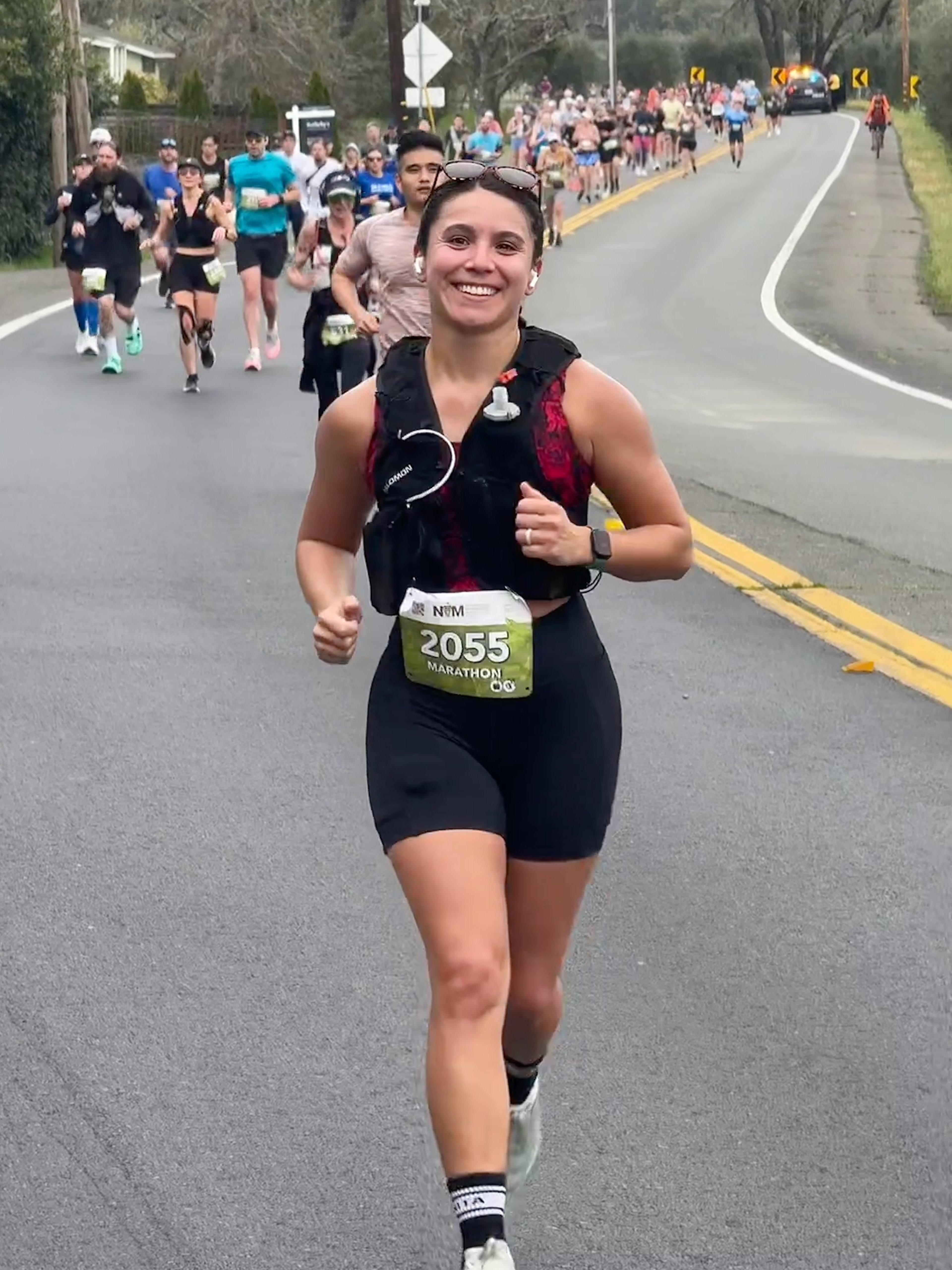
My first “official” race was in 2023, followed by another half-marathon a year later. After each race, I said the same thing: “I am glad I finished. I’m tired, and glad I don’t have to run more. I never want to do a full marathon.”
In the spring of 2025, I had another half-marathon, and I was determined to break two hours. At the time, my running strategy was to eat one banana before the run and maybe one gel after the first hour, depending on my blood sugar. I had heard that having insulin on board was dangerous for running, so I opted to have minimal fuel to avoid giving myself insulin.
On race day, my adrenaline was high, which I believe caused my blood sugar to be high, so I fueled less. I didn’t want to risk needing to pee and losing time, so I drank minimal water. While I did hit my time goal and achieved a personal best time, I felt so ill afterwards. I was nauseous the rest of the day, threw up twice, and recovered poorly. I knew that my fueling was the issue, but I did not know how to navigate fueling and running as someone with type 1 diabetes.
Later that year, when I signed up for another half-marathon, I was determined to approach this race differently. I kept a running log for each training run I did. I wrote my starting and ending blood sugar levels, and made a note if anything diabetes-related happened. The running log might sound like a lot of work, but I normally don’t spend more than 10 minutes on it. It’s still something I do today to help prepare – logging my runs helped me reflect on what worked well and what didn’t.
For this training block, I started to incorporate fuel. I kept track of how much insulin I would give myself for each gel, the amount of carbs in each gel, and when during the run I would eat it. When I reached the starting line, I felt prepared with a better fueling plan. As the race progressed, I had a sensor issue and did not receive blood sugar data the entire run. I knew my starting blood sugar before the race. So I stayed calm, stuck to my fueling plan of a pre-race banana and two gels with reduced insulin, and ran.
When I finished my race, I felt amazing and knew that I had the energy to run for another hour if I wanted. I had a better fueling strategy and connection to my body, and this race gave me the confidence to sign up for my first full marathon.
Marathon training led to new challenges around managing diabetes that surprised me. Here are a few examples, and how I navigated them over multiple runs:
- Time of day: I had done a majority of my runs in the morning because when I ran the same distance in the afternoon, I always went low. However, sometimes it was more practical to train in the afternoon, so I needed a new strategy. For afternoon training, I tried turning activity mode on my pump for at least one hour before a run, eating 15-20 g carbs without insulin 15-20 minutes before a run, and fueling more frequently than I would for a morning run. Some days I would be busy with work, and I could not practically prepare as well as I would like. But I ran anyway and learned how my blood sugar responded. Each run became a learning experience, and my confidence in managing my diabetes as a runner grew.
- Sensor issues: During this training block, I transitioned from the Dexcom G6 to the G7. My first month on the G7, I had constant issues. I would get a “Brief Sensor Issue” after 30 minutes of running, causing my sensor to stop giving me readings. It would not work again until 30 minutes after I stopped running, causing me to have no sensor data for up to three hours at its worst. I spoke to the Dexcom customer service and my endocrinologist, and decided to try a different overpatch to help secure my sensor. This seemed to resolve the issue (Skin Grip worked well for me).
- Phone battery: I use the Dexcom G7 integrated with the Omnipod, which both use apps on my phone. I also use the Nike Run Club app to track my runs. On longer runs, I share my location with my husband for safety. All of these apps can drain your battery, and on my long runs (15+ miles), I carry a portable charger to make sure my phone doesn’t die, and I don’t lose access to my CGM or pump.
 After three months of training, I felt nervous but ready for my first full marathon. My longest training run was twenty miles, so this race would also be my longest run ever. My pod was set to expire, so I planned to change it the night before. I placed a new overpatch on my sensor so it would stay secure. I ate a carb-filled dinner and had accommodations near the start line.
But the night before the race did not go as smoothly as I had planned. The new pod I put on? It didn’t deliver insulin properly, causing high blood sugars all night. I woke up in the middle of the night, corrected, and went back to sleep. When I woke up to get ready, my sugar was still high, so I changed my pod and reluctantly gave a small correction, meaning I had insulin on board before my race.
So far, I’ve had high blood sugar on every race day. I assumed it was because of adrenaline, and I expected the same for a marathon. When I got to the start line, my sugar had started to come down from a correction bolus. I ate my pre-race banana, which I typically give a small insulin bolus, but I decided that since I was trending down, I would eat it without insulin.
During my training, I had practiced giving small doses of insulin for each gel, about 20-30% of a full dose. Throughout the race, my sugar was lower than I would have preferred, but stable. I took most of my gels without insulin and watched how my sugar responded. I had one gel at 30 minutes, and after the first hour, I took a gel every 20 minutes. Over the course of my race, I consumed over 300 g of carbs, which is almost double what I eat on a normal day. I used to think that carbs were the enemy, but carbs are fuel and can give you the energy to do hard things.
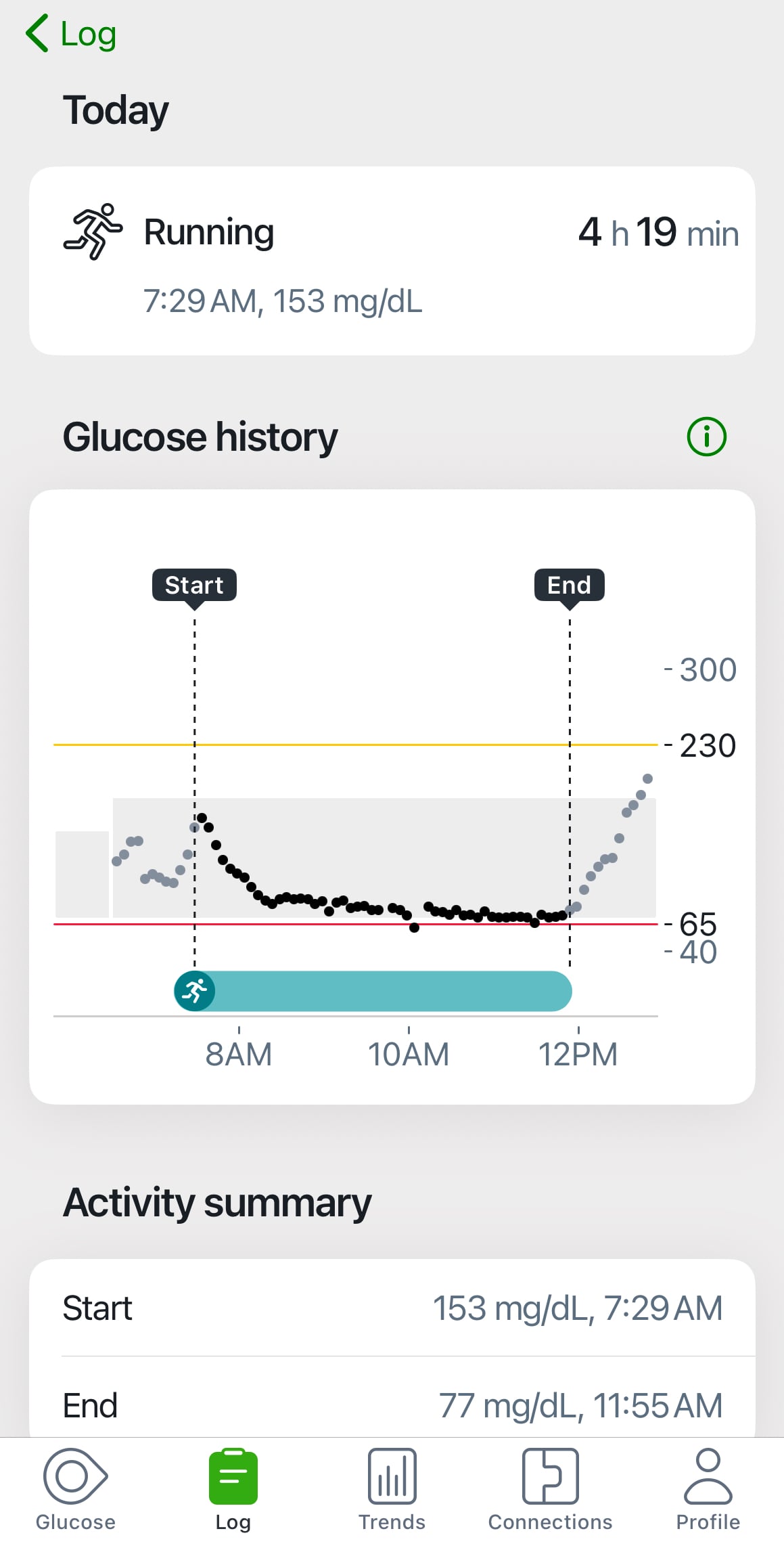
I started my race with a CGM reading of 153 mg/dL, and ended at 77 mg/dL. I only had one reading below 70 mg/dL, and consumed one extra gel and a few sips of lemonade beyond my fueling plan to keep my sugar in range. After long runs (2+ hours), I noticed that I tend to run low the rest of the day and sometimes even the following day. When I got home, I sipped on an entire container of lemonade throughout the afternoon to keep my blood sugar in range.
Diabetes used to make me afraid of running, but running helped me achieve confidence in managing my type 1 diabetes under changing circumstances. Not because of a single race, but because of months of training and experiencing different diabetes scenarios. I used to see myself as either a runner or as someone with diabetes. Once I embraced the idea of myself as an athlete with type 1, I fueled better, ran stronger, and my overall diabetes management improved. Running has helped me reconnect to my body.
Not every run will go smoothly with type 1 diabetes, but having a good run and nailing blood sugar levels is incredibly empowering.
Read other inspiring stories about people with type 1 diabetes here: